The single EU article that shapes every vape you can legally buy
Almost every legal limit on a vaping product sold in the European Union comes from one place: Article 20 of Directive 2014/40/EU, the Tobacco Products Directive, usually shortened to TPD. The Directive entered into force on 19 May 2014 and has applied in member states since 20 May 2016. Where a future revision may take it is tracked in our TPD III status guide.
Article 20 covers e-cigarettes and refill containers. It does not harmonise everything — flavours, disposable formats, taxation and retail channels remain national questions — but the product itself is defined by the TPD. If you have ever wondered why a bottle is 10 ml and a device is 2 ml, this is why.
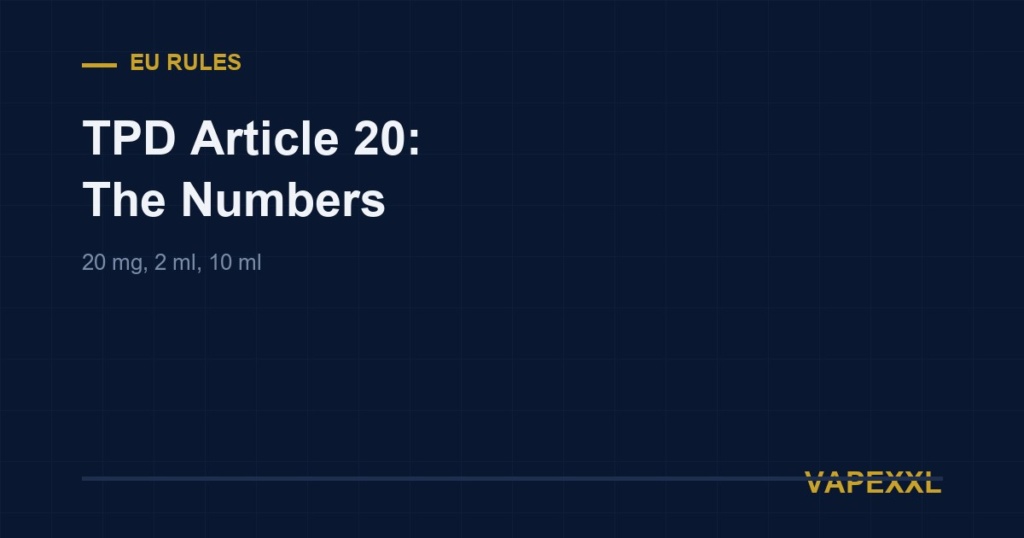
The four numbers that define an EU vape
| Limit | Value | Applies to |
|---|---|---|
| Maximum nicotine concentration | 20 mg/ml | All e-cigarette liquids |
| Maximum tank / cartridge volume | 2 ml | Single-use e-cigarettes, cartridges, tanks |
| Maximum refill container volume | 10 ml | Bottles of e-liquid sold for refilling |
| Notification lead time | 6 months | Before a product is placed on the market |
The 20 mg/ml ceiling is the reason our catalogue describes strengths as 0% and 2% rather than offering higher options. The conversion between the two ways of writing strength is explained in our percentage vs mg guide, and the question of whether 20 mg/ml is strong is covered in a separate explainer. Refill containers in the format the Directive allows are listed under e-liquid.
Notification before sale
Manufacturers and importers must notify the competent authority of each member state before placing a product on the market, submitting details of the product, its ingredients, emissions, nicotine dose and the components of the device. In practice this is filed through the EU-CEG portal.
The six-month lead time is why a genuinely new device or liquid never appears in EU shops immediately after a trade show. Some member states add a domestic filing on top of EU-CEG — Belgium is one example, as noted in our EU bans overview.
Labelling, warnings and packaging
Article 20 sets out what must appear on the pack and in the leaflet: a health warning, a list of ingredients, information on nicotine content and dose, and instructions for use and disposal. Packaging must not include promotional or misleading elements, and must not suggest health, energy, vitality or lifestyle benefits.
Whether a product complies with the TPD is a separate question from whether it is legal in a given country. Our packaging and labelling guide walks through what the law requires on the pack itself, and the how to read a vape label article decodes the markings you actually see.
Advertising and sponsorship
Article 20(5) bans commercial communications for e-cigarettes in print media, information society services — which includes websites and social platforms — and radio. It also bans cross-border sponsorship. The rule is judged on effect, not intent: an unfunded post by a shop can still breach it.
There is one narrow exemption for publications and broadcasts aimed exclusively at tobacco industry professionals. Everything else is covered by the EU advertising rules guide, and Germany's stricter interpretation is set out in our Germany explainer.
Article 24(3): how a country bans a product category
Article 24(3) lets a member state prohibit a category of product where it considers the prohibition necessary to protect public health. Several member states have used it for single-use vapes. The Commission issues an implementing decision on each notification, and a decision alone does not mean the national measure is already in force.
That distinction explains why there is no single EU disposable ban date. The current country positions are laid out in our bans overview, and the flavour layer — which is entirely national — is covered in the flavour bans guide.
What the baseline does not cover
The TPD does not harmonise:
- Flavours — the EU banned characterising flavours in heated tobacco in 2023, but not in e-liquid. National bans apply instead.
- Disposable formats — covered by national measures under Article 24(3).
- Taxation — a proposal to extend excise to e-liquid across all 27 member states requires unanimity.
- Retail channels and online sale — several member states restrict or prohibit remote sales, as set out in our Netherlands explainer and shipping restrictions guide.
- Where you may vape — a Council Recommendation, not binding law; see Germany's public-place rules.
Frequently asked questions
Is 2% the same as 20 mg/ml?
Yes. 2% nicotine by volume is 20 mg per millilitre, which is the TPD ceiling. See the conversion guide for the arithmetic.
Why is e-liquid sold in 10 ml bottles?
Because Article 20 caps refill containers at 10 ml. Tanks and cartridges are capped separately at 2 ml.
Can an EU shop advertise vapes on social media?
Cross-border advertising in information society services is prohibited by Article 20(5). Some national rules are stricter still, and Germany enforces the rule across all media.
Does TPD compliance let me sell anywhere in the EU?
No. Compliance with the Directive is the floor. National measures on flavours, disposable formats, retail channels and online sale can each shut off a market, which is why our shipping and restricted countries page lists them individually.
What happens to the TPD now?
The Commission's 2026 evaluation identified divergent national rules as a source of internal-market friction, and a public consultation ran during 2026. Evaluation, proposal, adoption and implementation are separate stages, so no new uniform rule should be assumed yet.